Benjamin Cressiot
  • Home
  • News
  • Research
  • Publications
  • Funding & Innovation
  • Team
  • Teaching
  • CV
  • Contact
  • ORCID

RESEARCH PROGRAMME

Reading chemistry, structure and information at the single-molecule level

My research develops biological and solid-state nanopores as electrical observatories for proteins, peptides, disease biomarkers and sequence-defined polymers.

Explore the research axes Selected publications

SINGLE-MOLECULE NANOPORE SCIENCE
How much molecular information can be extracted from one molecule?

Connecting pore architecture, molecular transport and quantitative ionic-current fingerprints.

TransportConformationIsomersPTMsSequence
SCIENTIFIC STRATEGY

From nanopore transport to molecular interpretation

A nanopore experiment is not only a detection event. The amplitude, duration, fluctuations and population structure of an electrical signal report on molecular charge, shape, conformation, dynamics and interactions with the pore. My programme connects these observables to chemically meaningful questions.

RESEARCH AXES

Four connected directions

01BIOLOGICAL NANOPORES

Engineering aerolysin as a molecular reader

Aerolysin is engineered as a highly sensitive electrical reader of proteins and peptides. Pore architecture, internal charge and electrolyte conditions are tuned to control capture, transport and signal resolution.

Engineered constrictionsElectro-osmotic flowTransport dynamics
Representative papersACS Nano 2025Chemical Science 2025ACS Sensors 2019
02SOLID-STATE NANOPORES

Transport and sensing in complex environments

Solid-state nanopores provide robust platforms for studying confined molecular transport and detecting biomarkers in demanding media. Controlled polymer environments and data analysis extend sensing toward serum-containing samples.

Confined transportPEG crowdingMachine learning
Representative papersNature Communications 2026ACS Nano 2023ACS Nano 2012
03DISEASE BIOMARKERS

Resolving clinically relevant molecular variants

Nanopore fingerprints distinguish closely related biomarkers through differences in terminal residues, stereochemistry, conformation or post-translational modification, including measurements in complex biological matrices.

Peptide isomersConformations & PTMsSerum analysis
Representative papersACS Central Science 2024ACS Central Science 2023Nature Communications 2025
04EMERGING APPLICATIONS

Reading molecular information and reactive species

Nanopore sensing is extended beyond conventional biomolecules toward sequence-defined digital polymers and reactive polysulfides involved in lithium–sulfur battery chemistry.

Digital polymersTransport control, engineered sensing regions and consensus-based decoding.PEPR MolecularXiv
Energy chemistrySingle-molecule identification of polysulfides and reaction intermediates.PEPR SENSIGA Batteries
Representative paperCommunications Materials 2020
NANOPORE READOUT

From pore structure to electrical fingerprint

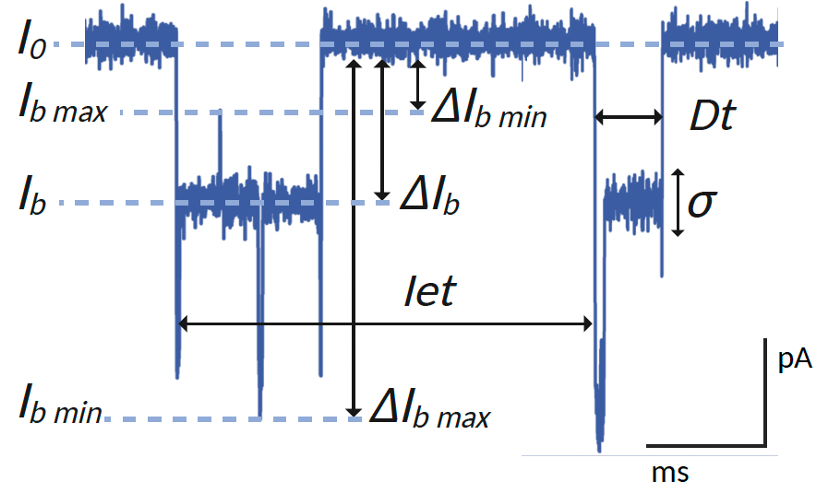
Annotated ionic-current trace showing blockade amplitude, dwell time and current fluctuations
Single-molecule ionic-current signatures. Blockade depth, dwell time and event fluctuations provide complementary descriptors of molecular identity, conformation and dynamics.
Rotating molecular structure of the aerolysin nanopore
Aerolysin nanopore architecture. Rotating view of the pore used as a single-molecule sensing element. Animation: Nano1FB, PDB 9FM6, CC BY-SA 4.0.
EXPERIMENTAL LOGIC

A complete chain from molecule to interpretation

1

Design the sensing environment

Pore, membrane, electrolyte, voltage and molecular conditions.

2

Control molecular transport

Capture, orientation, translocation, confinement and interactions.

3

Extract electrical fingerprints

Blockade depth, dwell time, fluctuations and event populations.

4

Resolve molecular identity

Chemical variants, conformers, biomarkers and encoded sequences.

SELECTED MILESTONES

Scientific progression

View publications →
2012–2015

Protein transport through protein and solid-state nanopores

Establishing a mechanistic foundation for confined protein transport and nanopore sensing.

2018

Biological adapters for solid-state nanopores

Thermostable viral portal proteins developed as programmable sensing elements.

2024

Peptide stereochemistry at the single-molecule level

Nanopore discrimination of a peptide biomarker and its enantiomer.

2025

Conformational and isomeric resolution

Electrical identification of subtle peptide states, including proline cis/trans isomers.

Current

Complex samples and molecular decoding

Advancing biomarker detection in realistic matrices and reading information encoded in synthetic polymers.

CAPABILITIES

Experimental and analytical expertise

∿

Electrophysiology

Low-noise ionic-current acquisition and event-level analysis.

◫

Protein nanopores

Aerolysin sensing, transport control and pore engineering.

⬡

Solid-state nanopores

Transport in confined media and complex samples.

◎

Biomarker analysis

Proteins, peptides, isomers and post-translational modifications.

▥

Data analysis

Multidimensional fingerprints, classification and machine learning.

⌁

Molecular design

Connecting chemistry, conformation and nanopore readout.

COLLABORATION

Advancing nanopore science across disciplines

Potential collaborations are especially relevant in peptide and protein chemistry, biomarker analysis, sequence-defined polymers, molecular modelling and energy materials.

ContactFunding & innovation

© 2026 Benjamin Cressiot

Research conducted within LAMBE · CNRS UMR 8587 · CY Cergy Paris Université

  • Google Scholar

  • ORCID